
Internal Champion Scorecard for Co-Sell Teams
Rate internal champions across five observable dimensions and turn scores into clear actions for co-sell pipeline reviews.
If I can’t score a champion with proof, I don’t treat that contact as deal strength.
This scorecard gives me a simple way to rate an internal champion on 5 areas: Access, Fit, Deal Pull, Funding Path, and Follow-Up. I use a 1–5 scale for each one, then sort the result into Strong (20–25), Developing (12–19), or Weak (5–11) so the team can stop arguing over gut feel and focus on the next move.
Here’s the full idea in plain English:
- Access: Can this person get me to the right people and share account details?
- Fit: Do they own the problem, and does the solution match a live Azure priority?
- Deal Pull: Are they pushing the deal inside the account when I’m not there?
- Funding Path: Can they name budget, approvals, and buying steps?
- Follow-Up: Do they reply on time and complete tasks each week?
A few numbers make the model easy to use:
- 5 scoring areas
- 1–5 score per area
- 25 total possible points
- 3 outcome bands
- 24-hour reply time is a top Follow-Up signal
- 48-hour reply time or more is a warning sign
What I like here is the shift from opinion to proof. Instead of saying, “This contact seems solid,” I can say, “They score low on Funding Path, so forecast confidence should drop until budget and procurement are clear.” That changes the meeting.
The article also makes one point I agree with: a friendly contact is not the same as a champion. If they don’t have internal pull, buyer access, and a reason to move the deal, they’re just a contact.
| Score Area | What I check | High score looks like |
|---|---|---|
| Access | Intros, reach, internal account detail | Direct intros made and timing shared |
| Fit | Problem ownership and Azure match | Clear owner, clear priority, clear usage upside |
| Deal Pull | Internal selling and motion | They move the deal without seller pressure |
| Funding Path | Budget and approvals | Budget source and buying path are named |
| Follow-Up | Speed and task completion | Replies within 24 hours and weekly cadence |
Bottom line: I’d use this scorecard in every pipeline review, pick the lowest score first, assign one action, set one owner, and add one due date. That keeps co-sell meetings tied to action instead of status talk.
How to Create Champions That Close 7-Figure Deals
The scorecard: 5 criteria to rate internal champions
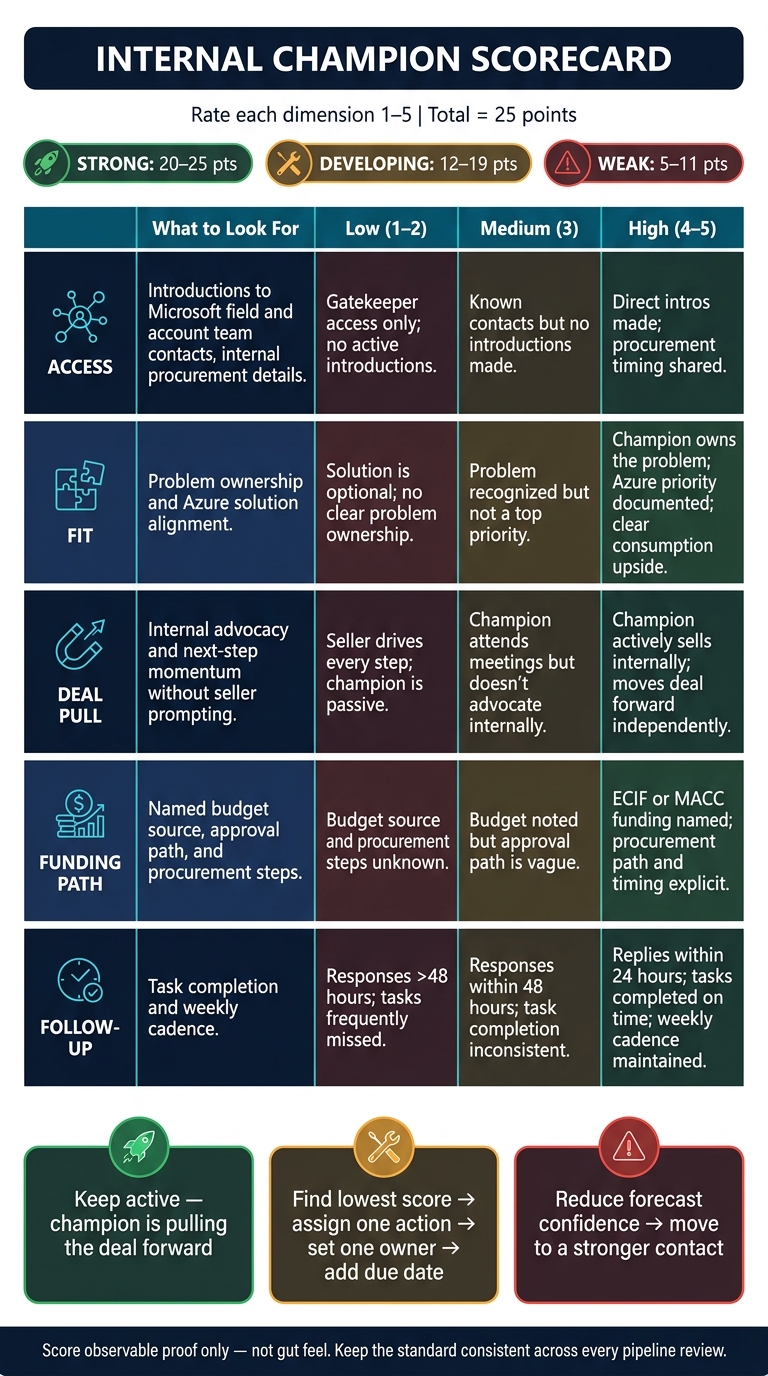 Use a 1–5 scale for each dimension, based on what you can see. That means things like a direct introduction, a named budget source, a completed task, or a shared timeline. Keep the standard the same in every pipeline review so a score means the same thing across deals.
These five dimensions turn a fuzzy “champion” label into something the team can use. The goal is simple: score observable proof, not gut feel.
| Dimension | What to Look For | Low (1–2) | Medium (3) | High (4–5) |
|---|---|---|---|---|
| Access | Introductions to Microsoft field and account team contacts, and internal procurement details | Gatekeeper access only; no active introductions | Known contacts but no introductions to Microsoft field or account team | Direct access to Microsoft field and account contacts; introductions made; procurement timing shared |
| Fit | Problem ownership and solution alignment with an account already using Azure | The solution is optional; no clear problem ownership | The problem is recognized but not a top priority | The champion owns the problem, the account is already using Azure, and the solution aligns with a documented priority and clear consumption upside |
| Deal Pull | Internal advocacy, business case movement, and next-step momentum without seller prompting | The seller drives every next step; the champion is passive | The champion attends meetings but does not advocate internally | The champion actively sells internally and moves the deal toward a real opportunity or win |
| Funding Path | Named budget source, approval path, and procurement steps | Budget source and procurement steps are unknown | Budget is noted, but the approval path is vague | The champion can name ECIF or MACC funding, and the procurement path and timing are explicit |
| Follow-Up | Task completion and weekly cadence | Responses take more than 48 hours and tasks are frequently missed | Responses come within 48 hours, but task completion is inconsistent | Responses come within 24 hours; tasks are completed on time; the champion keeps a weekly cadence |
Next, translate these scores into strong, developing, or weak champion calls.
Access: executive reach, stakeholder coverage, and internal information
Access isn’t about whether your champion knows people. It’s about whether they can get you to the right people and tell you what’s actually happening inside the account.
A 4 or 5 means the champion has already made direct introductions and shared details such as procurement requirements or internal timing. That’s a big difference from someone who says, “I know the right folks,” but never opens the door. Use an account heatmap to spot relationship gaps and coverage status instead of leaning on broad relationship claims [2].
Fit: problem ownership and solution alignment
A high Fit score means the champion owns the business problem your solution solves and the account is already using Azure. That matters because ownership drives action.
The clearest signal of a high score is a champion who can show clear consumption upside and connect the solution to a documented priority [3]. A medium score usually looks different: the problem is known, but it’s not urgent enough to push internal action.
Deal Pull: urgency, internal selling, and next-step momentum
“If it does not move pipeline, it should not be in the plan.” - Matt Barron, Founder, Barron Tech [1]
Deal Pull is where you separate a helpful contact from a real champion. The test is pretty simple: are they selling internally when you’re not in the room?
High scores go to champions who move assigned campaign work forward, help build the business case, and keep the deal moving toward a real opportunity or win. If the seller has to drive every step, that’s not strong Deal Pull.
Funding Path: budget source, approvals, and purchase timing
A lot of deals slow down late because budget confidence was vague from the start. A champion who scores 4 or 5 can name the budget source, such as ECIF or MACC funding, and walk through the approval and procurement path in concrete terms [1].
“They have budget” doesn’t tell you much. You need to know where it sits, how it gets approved, and when it can be used.
Follow-Up: response speed, task completion, and operating rhythm
Follow-Up is the easiest dimension to score because the proof is right in front of you. Do they reply within 24–48 hours? Do they finish the tasks assigned in the mutual action plan or campaign work, or do those tasks sit there untouched?
High scorers keep a steady weekly cadence and a cleaner operating rhythm [1][2].
How to score and interpret the results
Use a 1–5 scale with clear, observable definitions
Use a 1–5 scale and keep the definitions simple.
A 1 means there’s a clear gap. A 3 means you’re seeing partial progress. A 5 means there’s visible execution.
That standard needs to stay the same in every review. If the bar shifts from one deal to another, the scores stop meaning much.
Classify deals as strong, developing, or weak champion situations
Once you’ve scored all five dimensions, add up the total and use that number to decide what happens next. The point is to drive action, not get stuck in a scoring debate.
| Total Score | Classification | Action |
|---|---|---|
| 20–25 | Strong | Keep it active; the champion is moving the deal forward |
| 12–19 | Developing | Identify the weakest dimension and address it |
| 5–11 | Weak | Reduce forecast confidence; move the deal to a different contact |
After that, look at the lowest score and use it to set the next step.
A strong classification means the champion is actively pulling the deal ahead. A developing classification means you should focus support on the lowest-scoring dimension. A weak classification means the deal should be downgraded or moved to another contact before it takes up more team time. [3]
How to use the scorecard in pipeline reviews and co-sell meetings
Once you’ve scored a champion, don’t let the score just sit there. Use it to run the meeting.
Bring the scorecard into weekly pipeline calls, partner one-on-ones, and Microsoft deal reviews. The point is simple: use the scores to decide what happens next, not just to describe the deal.
Pipeline review flow: check score gaps and assign next actions
Start with the lowest score and turn that gap into one clear next step.
First, confirm the scores. Then pick the weakest dimension, assign one action, name an owner, and set a due date before the meeting ends. That keeps the conversation grounded and stops the meeting from drifting into vague follow-up.
Let the weakest dimension drive the next move. If Access is low, focus on getting connected to the right Microsoft field contacts, the account team contacts, or the client executive team. If Funding Path is the gap, check whether programs like ECIF or MACC are in play and use that to shape purchase timing. General notes like “follow up next week” don’t cut it. The action should match the gap.
Use Co-Sell Buddy to track champion scores, account coverage, and tasks in one shared workspace. [2]
Partner and Microsoft meeting flow: use the scorecard to sharpen deal execution
In joint meetings, use the scores to decide whether the deal should move forward, be repaired, or be reframed.
The score should point to the next move. Low Access usually means you need an executive introduction. Low Fit points to a tighter business case. Low Deal Pull means it’s time to build up the champion or find a second champion who can help move things along.
When to escalate, replace, or develop the champion
There are three common paths here, and each one calls for a different move:
- Develop the champion when the signs look good but the picture isn’t complete yet.
- Escalate when the champion is willing but blocked, especially if they can’t reach the client executive team or can’t get through approvals and timing.
- Switch to a different champion when the contact keeps scoring low on Deal Pull and Follow-Up, has little internal pull, or stops following through between meetings.
Base the decision on the lowest-scoring dimension. Then record the action, owner, and due date.
Conclusion: Keep champion scoring simple, consistent, and tied to action
A strong internal champion can be measured. This five-part scorecard gives co-sell teams one shared way to judge Access, Fit, Deal Pull, Funding Path, and Follow-Up. But the scorecard only matters if it leads to action.
Each score should lead to a clear next step and a clear owner, not just sit there as a status update.
Use the scorecard during weekly pipeline reviews so next steps stay current. Keep the scorecard, relationship map, and action items in one shared workspace. [2]
Simple scoring. Clear ownership. Faster movement.
FAQs
How often should we rescore a champion?
Rescore your internal champion during weekly pipeline reviews. That keeps champion data accurate and useful as deals move forward and the funding path changes.
Use the scorecard in your regular weekly 1:1s and pipeline calls. It helps your team stick to a steady co-sell rhythm and stay focused on high-quality pipeline.
What if two score areas are equally low?
Start with the area creating the most immediate friction in the current engagement. If that isn’t obvious, use the account context and heatmap in Co-Sell Buddy to spot where visibility is lowest or momentum has stalled the most.
Pick the area that can also help open up the other low-scoring category. Then use your next pipeline review to line up on the gaps and assign follow-up tasks.
Can one strong contact score make up for a weak funding path?
No. One strong contact can’t fully make up for a weak funding path.
In pipeline reviews, treat funding as a structural requirement. If the funding motion - or missed-funding signals - isn’t clear, outcomes will stay uneven even with the right people engaged. Use the scorecard so contact-driven deal pull earns movement only after access and the funding path are validated.