
· 11 min read
Qualitative Coding: How AI Groups Customer Feedback
Use AI for first-pass qualitative coding: de-identify notes, pilot a codebook, review labels, and turn reviewed themes into actions.
In this article
AI can suggest labels for customer feedback. People must check what those labels mean. Start with a research question, remove identifying details, and test a shared codebook on 5–10 passages before coding all the notes.
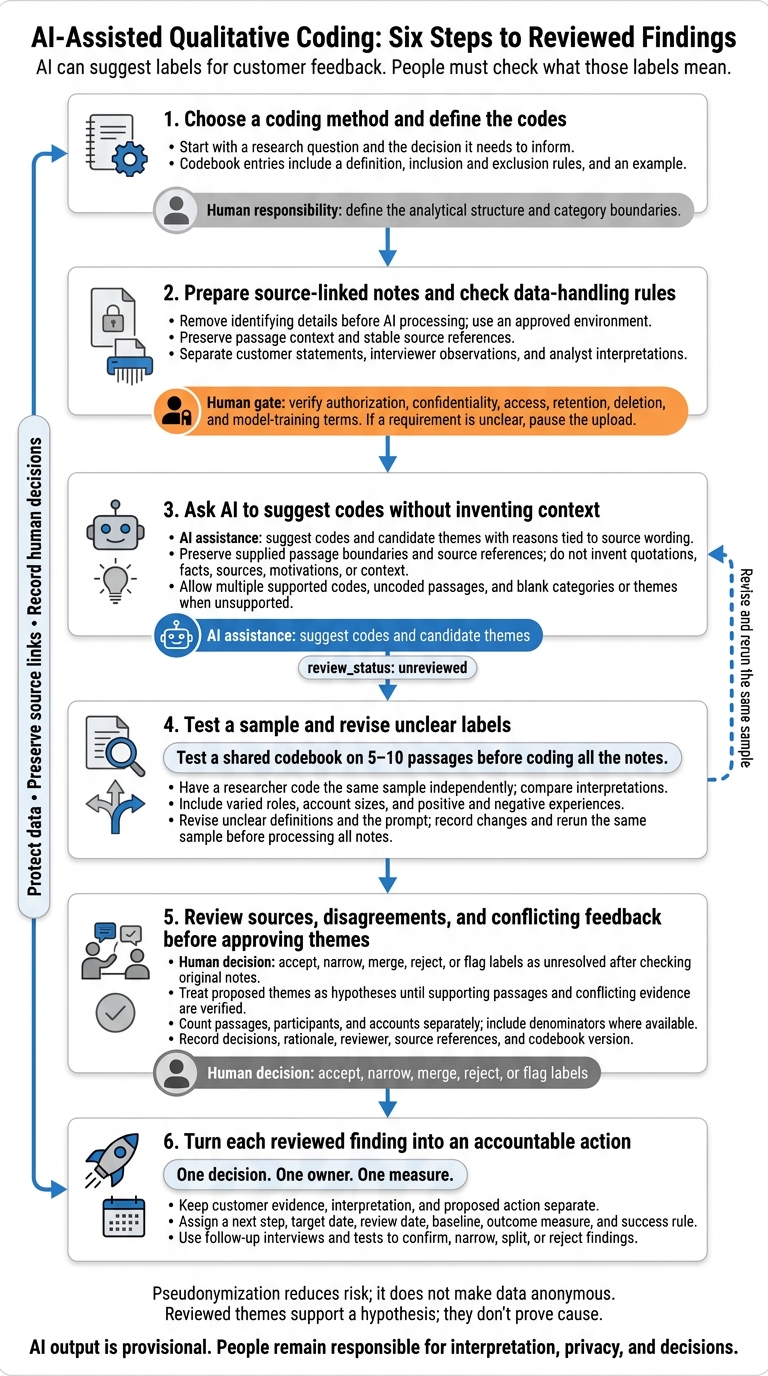
Qualitative coding turns interview notes into codes, categories, and themes linked to their sources. This guide covers six steps:
- Choose a coding method and define the codes.
- Prepare source-linked notes and check data-handling rules.
- Ask AI to suggest codes without inventing context.
- Test a sample and revise unclear labels.
- Review sources, disagreements, and conflicting feedback before approving themes.
- Turn each reviewed finding into an action with one owner and a measure of success.
The goal isn’t just grouped feedback. It’s a checked finding that supports a decision - with a record of how that decision was reached.
Prepare Interview Notes and Protect Customer Data
Standardize Passages and Source Details
Step 2: Build a source-linked working dataset that’s ready for review. Store raw notes in a restricted location. Split passages when the topic or claim changes - not after a set number of sentences. Keep the problem, business effect, and workaround together when they explain a single observation. Retain qualifiers that affect meaning, such as timing or workflow context.
Assign each interview a stable pseudonymous source ID and each passage its own reference. Record the source ID, speaker, passage text, and metadata needed to trace each claim: persona, company-size band, workflow, product area, and interview date. Format dates as November 12, 2026.
Clearly separate customer statements, interviewer observations, and analyst interpretations. Label paraphrases as paraphrases, not quotes.
Remove Identifying Details Before Using AI
Replace names, email addresses, account numbers, meeting links, and identifying business details with consistent markers. Remove contract terms, credentials, security details, and unreleased plans that aren’t needed for the analysis.
Check combinations of indirect identifiers, too. An unusual job title, exact headcount, location, or unusual event may identify someone when combined with other details. Use broader fields only when the finer detail doesn’t change the coding decision.
Pseudonymization reduces risk; it does not make data anonymous. Keep the re-identification key separate, encrypted, and under restricted access - not alongside the analysis file.
Before processing, verify authorization, customer commitments, data-minimization requirements, and the system’s approved data classification. Check access controls, retention periods, deletion procedures, and model-training terms for both prompts and outputs. Apply these checks to enterprise-approved and locally hosted systems alike. If any requirement is unclear, pause the upload.
Divide Preparation Tasks Between AI and People
Use AI for preparation, not final judgment. Never upload raw sensitive notes to an unapproved service just to request de-identification. Within an approved environment, divide the work as shown below. Before releasing the dataset for coding, record the reviewer, date, transformation applied, unresolved questions, and approval status.
| Preparation task | AI assistance | Required human check |
|---|---|---|
| Formatting | Standardize fields, speaker labels, and dates | Confirm wording and speaker attribution remain accurate |
| Passage segmentation | Suggest topic boundaries | Preserve context, qualifiers, and meaning |
| Metadata extraction | Identify persona, company-size band, workflow, and product area | Verify against notes; remove unnecessary or identifying fields |
| Sensitive-data detection | Flag identifiers, secrets, and deal terms | Check for missed disclosures and unnecessary redactions |
| Preliminary grouping | Suggest related passages for review | Verify source links and preserve context and conflicting passages |
How to Use AI to Brainstorm Codes in Qualitative Analysis (Step-by-Step)
Use AI to Suggest Codes and Themes
Step 3: Use AI for first-pass coding, not final interpretation. Before processing, recheck retention, training-use, access, and confidentiality settings.
Use the prompt below to keep AI focused on labeling rather than interpretation.
Write a Prompt That Links Labels to Sources
Add your research question, participant context, and codebook to this reusable prompt. For each codebook entry, include a definition, inclusion and exclusion rules, and an example.
Research question:
[Insert the study question.]

Participants and context:
[Insert relevant personas, workflows, product area, and interview period.]

Codebook:
[Insert code names, definitions, inclusion/exclusion rules, and examples.]

Task:
Use existing codes where they fit. Flag proposed new codes that align with the research question.
Allow multiple codes per passage when the text supports each one.
Allow passages to remain uncoded and categories or themes unassigned.

Rules:
- Preserve supplied passage boundaries and source references.
- Do not invent quotations, facts, sources, motivations, or context.
- Flag missing context, ambiguity, contradictions, and alternatives.
- Suggest candidate themes only when several passages show the same pattern. Include supporting references in reason.
- Leave category and candidate_theme blank when unsupported.
- Set review_status to "unreviewed" for every output.
- Model confidence is not a reliable probability and cannot replace human verification.

Return JSONL with one record per suggested code, using the supplied passage text unchanged.

Fields:
passage, source_reference, suggested_code, category,
candidate_theme, reason, uncertainty_note, review_status
Require reasons tied to observable wording, not assumed feelings or causes. Keep categories separate from review status: an unassigned category stays blank, while review_status stays unreviewed.
Test a Sample Before Coding All Notes
Step 4: Pilot the prompt on a small sample before coding the full dataset. Include administrators, daily end users, finance stakeholders, and implementation leads from accounts of different sizes. Cover both positive and negative experiences.
Have a researcher code the same sample independently, then compare interpretations. This test shows whether AI can group feedback without losing source context.
The example below shows the restraint to look for.
Fictional, unreviewed suggestion supplied for practice
passage: “We export the report before every renewal review because the dashboard numbers are hard to reconcile.”
source_reference:
INT-04-P11
suggested_code:export confusion
category: unassigned
candidate_theme: unassigned
reason: The participant describes exporting data to resolve difficulty reconciling dashboard numbers.
uncertainty_note: Surrounding context is needed to distinguish reporting reconciliation, dashboard trust, or a workflow limitation.
review_status:unreviewed
Here, export confusion may wrongly suggest trouble using the export feature. Check the surrounding notes before considering dashboard_reconciliation_problem, manual_reporting_workaround, or both.
Before rerunning the sample, check for broad labels, duplicate codes, and overlapping definitions. Revise the definitions and prompt, record your changes, and rerun the same sample before processing all notes.
Review Codes and Check Theme Support
After the pilot, compare each suggestion with the source notes and codebook before approving a theme. Step 5: Compare AI suggestions with the original notes and record human decisions; treat proposed themes as hypotheses until reviewers verify the supporting passages and conflicting evidence.[6]
Resolve Code Differences and Category Boundaries
Check each label against the full source passage, including qualifiers, timeframes, and speaker context. Merge synonyms, split codes that combine different ideas, and state what belongs inside - and outside - each category.
For export issues, separate discoverability, unavailable capability, and permission limits.
If the notes don’t support a clear explanation, keep an uncertainty code or flag the passage for follow-up. When reviewers disagree, compare their reasons with the codebook. If the disagreement could affect the findings, bring in a third reviewer or mark the passage unresolved. If a definition changes, revisit the affected passages.[6][7]
Weigh Frequency, Impact, and Conflicting Evidence
Once labels are reviewed, check whether each pattern has enough support to become a theme. Count passages, participants, and accounts separately, and include denominators where available. Repeated mentions from one account don’t establish broad customer demand.
Check severity and measured impact, such as blocked adoption, delayed implementation, or security risk. Keep conflicting evidence and check for differences by role, plan, or workflow. Don’t invent revenue estimates or apply findings from a small sample to all customers.
| Review task | AI suggestion | Required human decision | Evidence needed |
|---|---|---|---|
| Label selection | Assign a broad code | Accept, narrow, merge, or reject | Full source passage and code definition |
| Context check | Infer a missing capability | Distinguish availability, discoverability, and access | Qualifiers, user role, product state |
| Conflict check | Combine differing experiences | Preserve exceptions; define boundaries | Supporting and conflicting sources; participant and account counts |
| Privacy check | Include a detailed quote | Retain, redact, paraphrase, or exclude | Consent, identification risk, contract restrictions |
| Theme approval | Promote a grouping to a finding | Approve, revise, defer, or reject | Reviewed sources, shared meaning, impact, reviewer rationale |
Keep a Record of Evidence and Review Decisions
Keep a review trail so later readers can trace each decision. Record source references, original and final codes, category, theme, decision, rationale, reviewer, review date, and codebook version. Explain why each theme was approved, revised, or rejected, including any unresolved evidence. Track both reviewed passages and passages with updated codes so later reviewers can see where interpretations changed.[9]
Store the AI model, version or workflow ID, prompt version, processing settings, and data-handling procedures in access-controlled records.[3][5] Link to sensitive evidence instead of copying it, and protect review logs and outputs too.[8] This trail supports accountability, though later AI runs may still produce different results.[3][5]
Turn Reviewed Themes Into Actions
Step 6: Turn each reviewed theme into one decision, one owner, and one measure. Keep customer evidence, interpretation, and proposed action in separate fields.[13]
Separate Findings From Recommendations
Create a finding record that includes the theme and its definition, supporting categories and codes, representative evidence references, customer segment, contradictory or negative cases, business impact, limitations, unresolved questions, and confidence level. Link it to one recommendation: a single action tied to one reviewed finding.[12][14]
Match the fix to the problem. Use product changes for interaction problems, onboarding for new-user gaps, documentation for unclear instructions, and customer-success help for account-specific coaching or configuration.
Recommend testing clearer export navigation or guidance only when reviewed evidence supports navigation friction.
Reviewed themes support a hypothesis; they don’t prove cause. Set priorities based on impact, evidence strength, urgency, and effort.[14][15]
Once you’ve documented the finding, assign the follow-up work and choose the metric that will show whether it helped.
Assign Owners and Measure Results
Give each accepted recommendation one accountable owner, a next step, target date, review date, baseline, outcome measure, and success rule. Measure task completion, time on task, errors, and assistance under defined conditions.[11] Keep follow-up metrics separate.
One follow-up metric is support contacts per 100 active accounts.
Fewer tickets alone don’t prove the change worked. Training, customer mix, or reporting volume may also change.
Apply the same privacy controls to follow-up notes, recordings, and support data. Minimize identifiers, redact before AI processing, encrypt retained material, and restrict access by role. Even de-identified narratives can identify a customer.[4][10]
Use new interviews and test results to confirm, narrow, split, or reject the finding. Give unresolved questions a method and an owner - not a recommendation.[16]
Conclusion: Verify Findings Before Acting
After coding and review, approve themes only when codebook, privacy, pilot, and source checks are complete. Start with the research question and the decision it needs to inform. AI output is provisional. People remain responsible for interpretation, privacy, and decisions.[17][18]
Before acting, complete this final check:
- [ ] Clear structure: Codes include clear definitions, inclusion and exclusion rules, and examples. Categories have distinct boundaries, and themes answer the research question.
- [ ] Verified evidence: Every claim links to source passages. Reviewers record corrections, disagreements, rejected labels, and exceptions.
- [ ] Honest limits: Document contradictory evidence, missing segments, ambiguous passages, and unresolved uncertainty.
- [ ] Data handling approved: Confirm that the AI service, account, and contract are approved for this data. Remove or protect identifiers, restrict access, and apply retention and deletion rules to notes, outputs, and temporary copies.[19][20]
- [ ] Accountable action: Separate findings from recommendations. Assign each action one owner, a due date, a baseline, a target, and a follow-up review date.
FAQs
How do I choose the right coding method?
Score each task from 1 to 5 on revenue impact, frequency, setup effort, and client risk. Use those scores to prioritize where AI can help, then assign each task to a category:
- Assist: AI drafts; you decide.
- Review: AI drafts; you validate.
- Protect: Restrict sensitive information; humans keep full control.
Run a 30-day pilot and track accuracy and net time savings. Use the results to decide whether to scale, revise, pause, or retire the workflow.
How much feedback is enough to support a theme?
A theme has enough support when it shows up in multiple interviews, not just one anecdote. It also needs dated, source-linked notes that you can check against discovery records.
Group themes from discovery-note samples, then have a human review AI drafts for accuracy and relevance. Human review and approval help keep AI from overstating priorities or inventing urgency or impact [1][2].
How can I test whether AI misses important feedback?
Compare AI outputs with your original engagement records, not just the AI draft. During a 30-day pilot, score both manual and AI-assisted deliverables for accuracy, completeness, and scope fit. Track correction counts and minutes spent on rework to spot gaps.
Tell AI to mark missing inputs as NEEDS CONFIRMATION instead of guessing. Check facts, milestone status, and conclusions yourself against the source notes, making sure no client priority was missed.